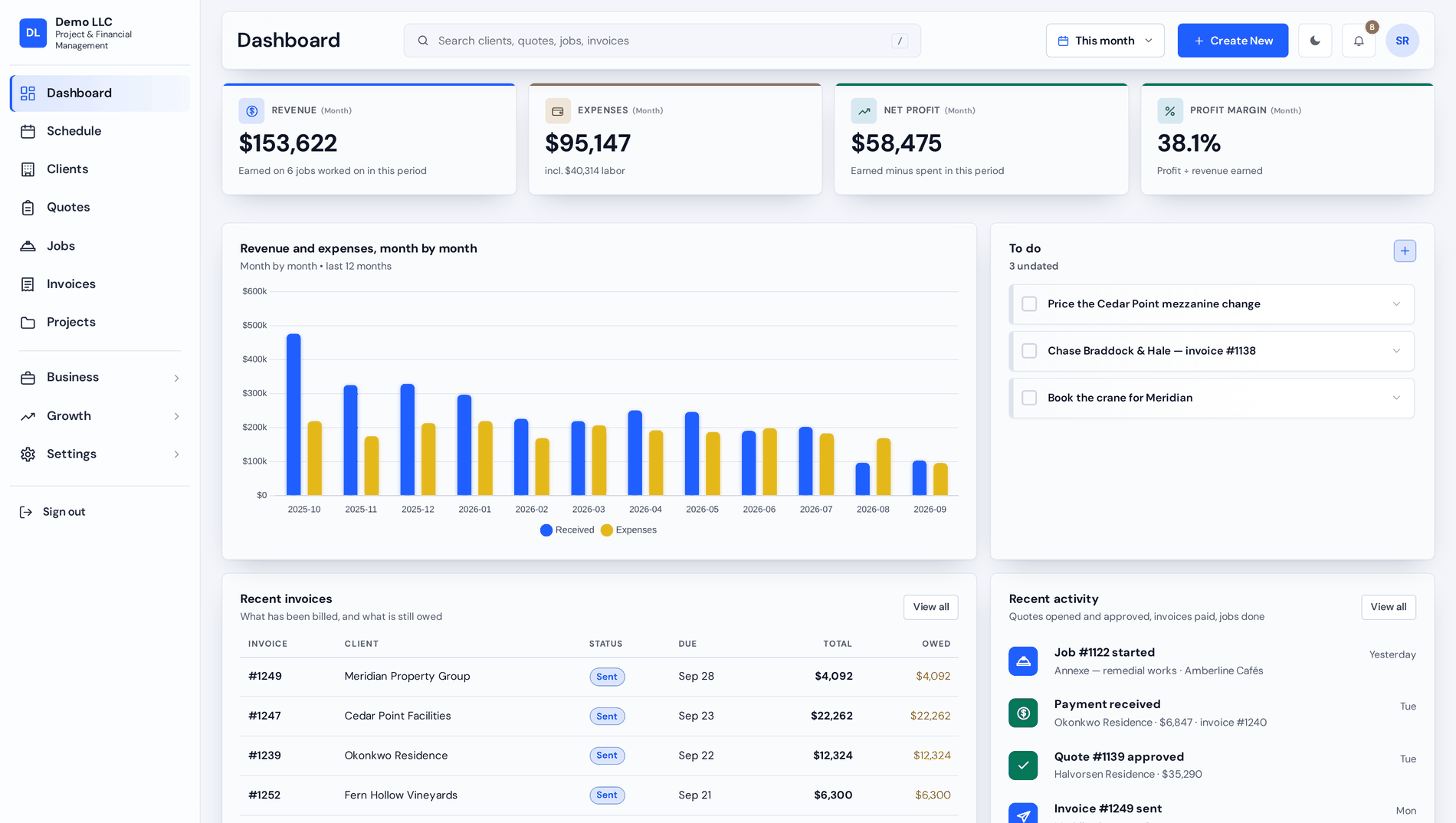
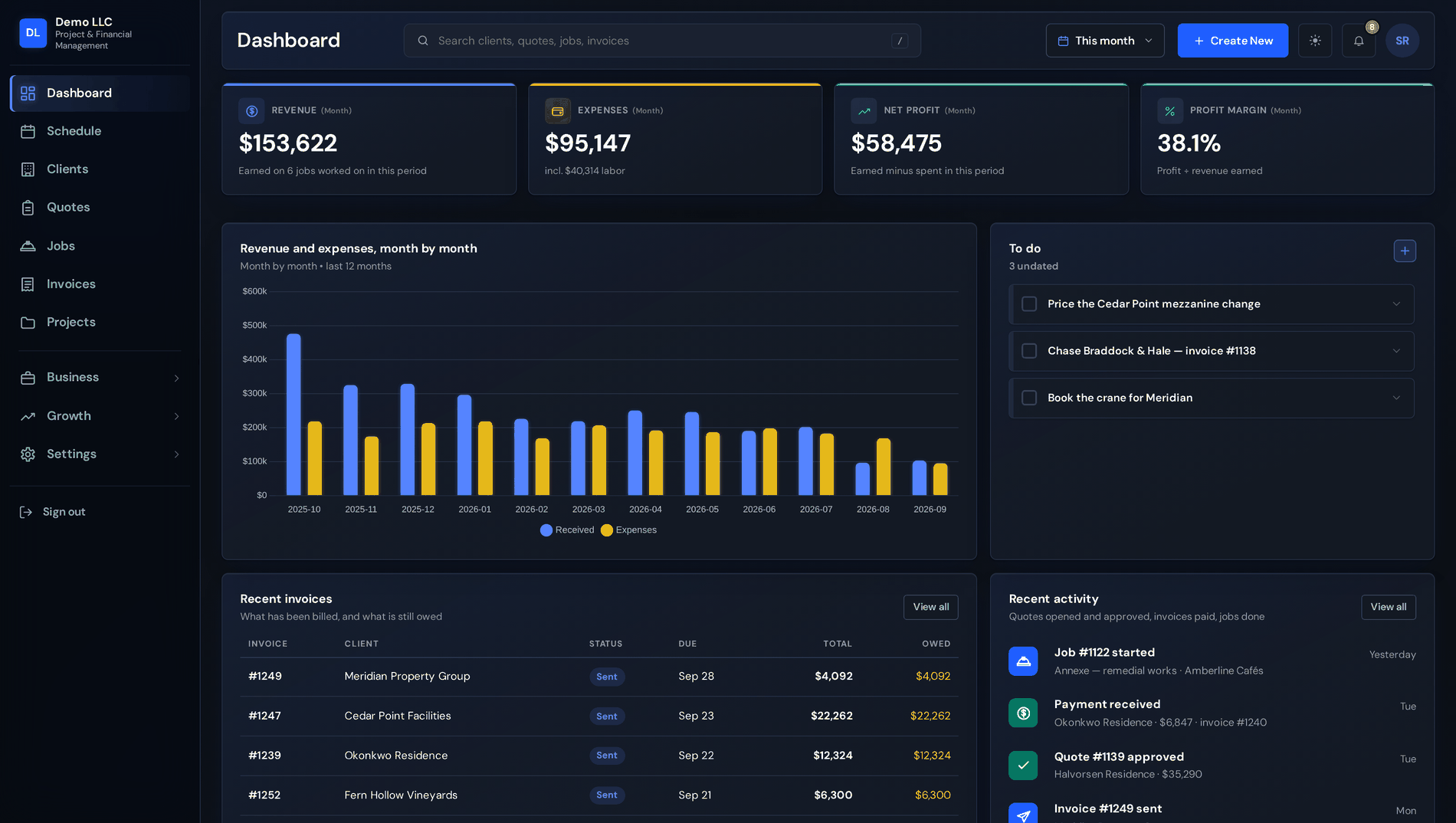
Start a workspace
Built on a job site, not in an office

Quote it. Schedule it. Invoice it.
Know what it made you.

One place for quotes, change orders, jobs, invoices, payments, crew hours and what it costs to keep the doors open — so the margin on a job is a fact you can look up, not a feeling you get at the end of the month.

Free while it is in testing · No card · Your own private database

yourcompany.orindesk.com/dashboard

Dashboard

Nine months in · 15 jobs · 4 quotes waiting on an answer

+ New quote
Contract value$713k▲ 18% on last quarter
Collected$596k$117k still owed
Profit$254k35.6% margin
Day rate to run$1,840before a shovel moves
Revenue, month by month
Cost Profit kept
0$25k$50k$75k$100k$125kJanFebMarAprMayJunJulAugSep$41.2k kept
Wants an answer
Change order #14 unansweredLarkspur B · sent 6 days ago
Invoice #221 is 12 days late$18,400 · Fenwick Yard
Quote #1017 opened twiceKestrel Logistics · $74,500
Marsh Lane finishedReady to invoice · 31% margin

Quotes & proposals Change orders Jobs & visits Invoices & payments Expenses & receipts Crew hours Company overheads Your own branding

Sound familiar?

The work is the easy part.

Nobody starts a trade business because they enjoy chasing paper. Here is what it usually costs before anybody notices.

The profit is a guess

The quote is in one program, the receipts are in a shoebox and the hours are in somebody's phone. Nothing puts them on the same page, so the margin is whatever the bank balance looks like on Friday.

You find out too late

A job that lost money tells you six weeks after the invoice was paid — which is about five weeks after you quoted the next one the same way.

Extra work goes unbilled

The customer asks for something once the walls are open, the crew does it, and nobody writes it down. That conversation is worth thousands a year.

Where the money went

Every receipt and hour lands on the job it paid for.

So the margin on a job is not a feeling. It is a number you can open, and it moves the moment a cost lands against it.

  • Cost at the bottom, profit stacked on top. The top of the bar is revenue. Drawn as two lines, cost is always the taller one and a good month looks like a bad one.
  • Overheads counted too. Insurance, the yard, the trucks, the phones — spread across the work, so a job that looked profitable at 20% can tell you it was not.
  • Change orders carry their own money. Raised against the job, approved by the customer, and on the invoice.
Revenue, month by month
Cost Profit kept
0$25k$50k$75k$100k$125kJanFebMarAprMayJunJulAugSep$41.2k kept
Margin, job by job
Kestrel — warehouse mezzanine 41%
Alder Street — kitchen fit-out 37%
Fenwick Yard — slab and drains 34%
Marsh Lane — roof replacement 31%
Larkspur B — roof (decking found rotten) 29%

Figures from the demo workspace, not a customer's books.

What it does

The whole job, start to paid.

One workspace, from the first site visit to the money in the bank.

Quotes your customer can approve

Send a link and a PDF. They approve it with their name and the date, and the job is ready to schedule. Change orders work the same way, mid-job, when the walls come off and the price changes.

Jobs, visits and the crew

Book the visits, see the week, and let the status look after itself — a job due to start today is in progress without anybody remembering to say so. Ten days on site means ten working days, not ten with a weekend inside it.

Invoices and what is owed

Invoice from the quote or from scratch, take deposits and part payments, and see who owes what without opening a spreadsheet. Late ones say so.

Costs against every job

Receipts, materials, dump fees, subs and hours land on the job they belong to, so the margin is a fact rather than a feeling — and you see it while there is still time to do something about it.

What the company costs to run

Insurance, the yard, the trucks, the phones. Your monthly run rate, and what a working day costs you before anybody picks up a shovel.

Your branding, not ours

Your logo and your colours on the quotes, the invoices, the emails and the page your customer approves on. Nothing on it says our name.

Quote #1017 · your customer's copy
Warehouse 2 — second mezzanine

Prepared for Kestrel Logistics · held 30 days

$74,500
Mezzanine — second baySteel deck, stair and balustrade 1$68,000.00
Edge protectionSupplied and fitted 1$4,100.00
Make good and clean downOn completion 1$2,400.00
✓ Approve this quote Ask a question

The customer's side

One link, and a yes you can prove.

No account for them to make, no app to download, no PDF to print and sign and scan.

  • Their name and the date, recorded. An approval you can point at six months later when somebody remembers it differently.
  • Approved on paper counts too. Customers say yes on the phone and on site far more than they click links — so the office can record that as well, and the pipeline stays true.
  • The job is ready the moment they agree. Schedule, visits, invoice and margin all follow from the quote you already wrote.

The week

Where everyone is, on one screen.

Book a visit for every working day of a job in one go, or drop them in one at a time. The office opens on the whole crew, not on its own empty diary.

  • Your working days, not ours. A crew that works Saturdays gets Saturdays.
  • Who sees what is up to you. The crew see the work; money stays with the people who deal with money.
Schedule · this week · everyone
Mon 7
Larkspur BRoof · 7:00–15:30
Alder StFit-out · 8:00
Tue 8
Larkspur BRoof · 7:00–15:30
Site visitMarsh Ln · 13:00
Wed 9
Larkspur BRoof · 7:00–15:30
Alder StFit-out · 8:00
DeliverySteel · 10:30
Thu 10
Larkspur BRoof · 7:00–15:30
Fri 11
Larkspur BSnag & clear
Fenwick YardPour · 6:30

Why this exists

I built it because I needed it.

I run a contracting business. For years the office ran on a quoting tool that could not tell me what a job made, a spreadsheet that could, and a shoebox that decided whether the spreadsheet was true.

Every piece of software I tried was written by people who had never stood in a basement at seven in the morning working out whether the extra work the customer just asked for was worth doing. They were beautiful, and they were built for somebody else's business. The ones that did the money did not do the crew. The ones that did the crew wanted a monthly fee per person to do it badly.

So this was built on real jobs, by somebody doing them, and every part of it exists because something went wrong once and I did not want it to go wrong again. The change order screen exists because of a conversation in a stairwell that cost me four thousand dollars. The overheads page exists because I once quoted a whole winter at a margin that turned out to be nothing.

It is not trying to be everything. It is trying to be the thing that tells you, on a Tuesday, whether the work you are doing is worth what you are being paid for it.

EL
Eduardo Laux Contractor · builder of Orindesk

Getting going

Three steps, about ten minutes.

Your own workspace at your own address. Your data is yours alone — a separate database, not a row in a shared one.

Pick your address

yourcompany.orindesk.com — yours, and what the crew bookmarks.

Add your people

Invite the office and the crew, and decide who sees money and who does not.

Quote your next job

Everything follows from the quote — the job, the visits, the invoice and the margin.

Your data, on its own

Every company gets its own database, backed up nightly, and a copy you can download and keep whenever you like. A backup you hold yourself is the one that survives anything — including us.

Works on the phone

The same workspace in a truck as on the office desk. Nothing to install and nothing that needs the crew to learn a second app.

Nothing to migrate first

Start with your next quote. There is no import to survive before the thing is any use to you.

Try it on your next job.

Free while it is in testing. No card, and nothing to uninstall.

Takes about ten minutes · Your own address · Your data stays yours